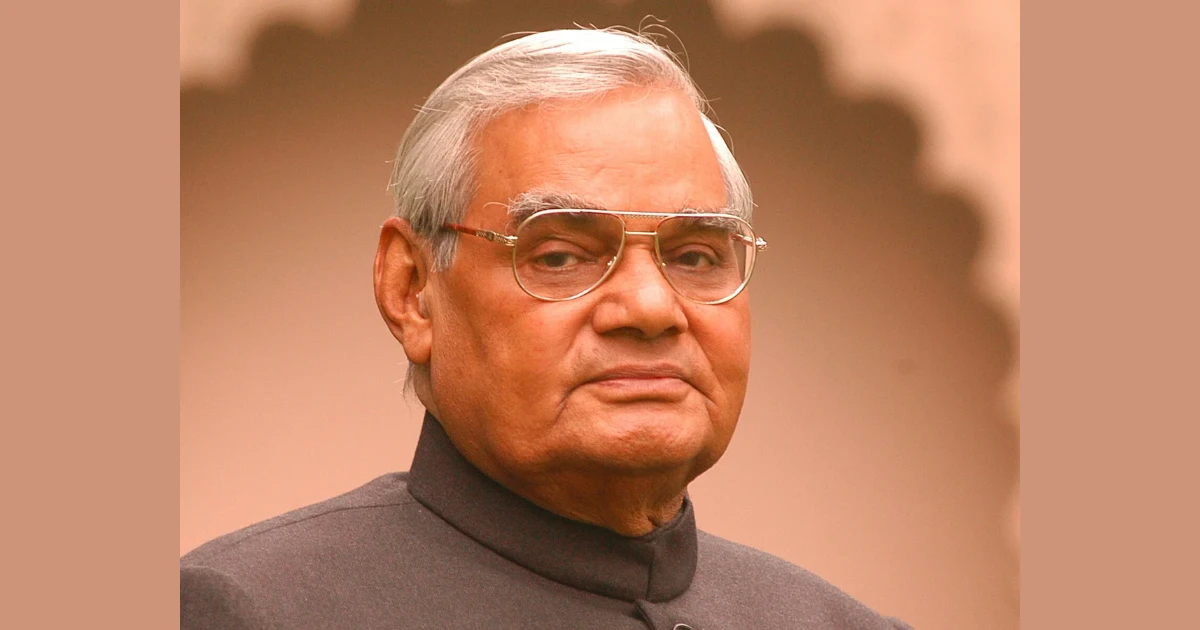
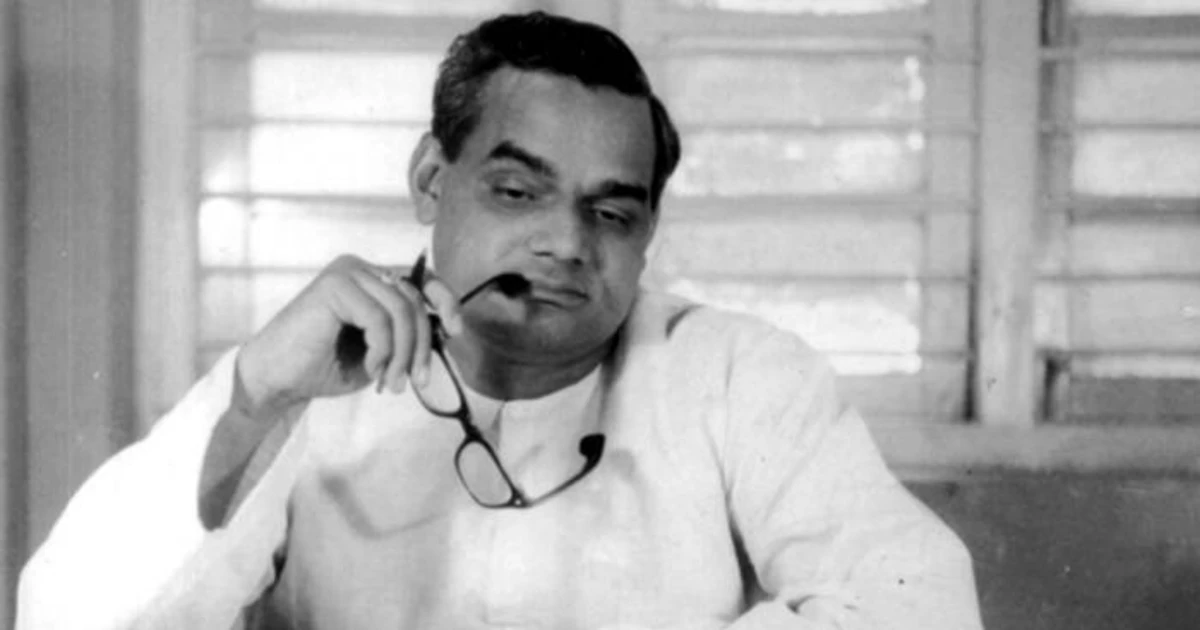
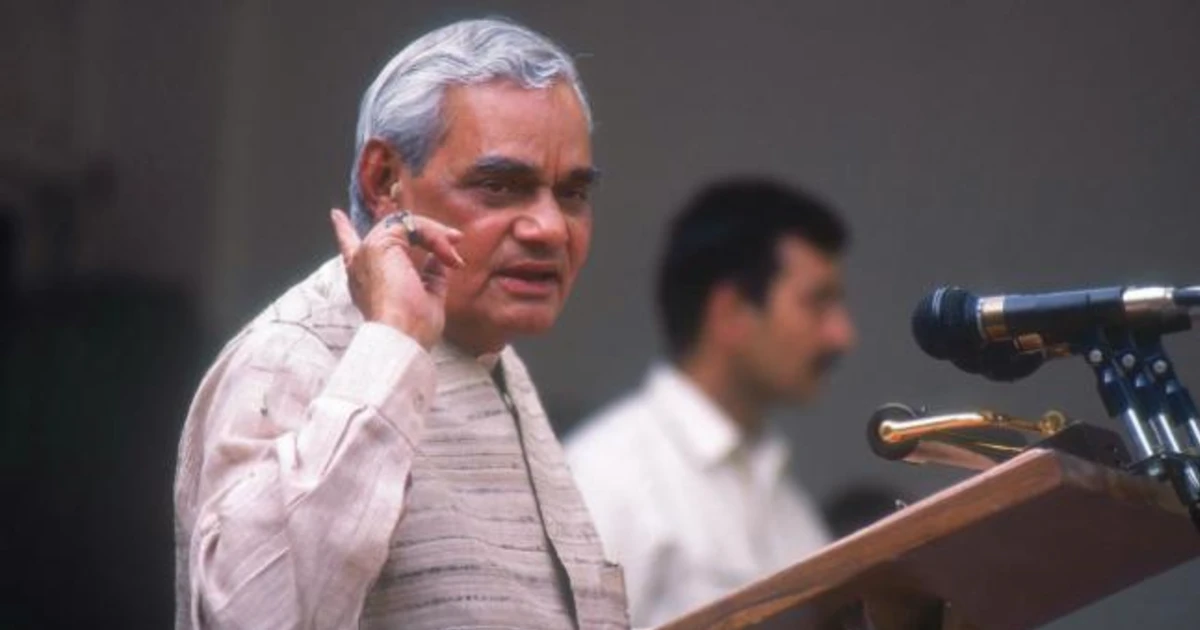
Atal Bihari Vajpayee (25 December 1924 – 16 August 2018) was a poet, journalist, parliamentarian, and three-time Prime Minister of India - the first non-Congress leader to complete a full five-year term.
Early Life and Education
Born in Gwalior, Madhya Pradesh, to Krishna Bihari Vajpayee, a schoolteacher and poet, and Krishna Devi. The family originally hailed from Bateshwar, Uttar Pradesh. His father's literary bent shaped Atal's lifelong relationship with Hindi poetry.
He studied at Saraswati Shishu Mandir and Victoria College (now Laxmibai College) in Gwalior, earning a BA in Hindi, English, and Sanskrit. He completed an MA in Political Science with distinction from DAV College, Kanpur. He enrolled for law studies but discontinued them to join the freedom movement.
Entry into Public Life
In 1939, he joined the Rashtriya Swayamsevak Sangh as a swayamsevak, becoming a full-time pracharak in 1947. He was briefly jailed in 1942 during the Quit India Movement.
He worked as a journalist, editing Rashtradharma (Hindi monthly), Panchjanya (weekly), and the dailies Swadesh and Veer Arjun. He became a close aide to Syama Prasad Mukherjee, founder of the Bharatiya Jana Sangh, and was with him during his fatal detention in Kashmir in 1953 - an experience that profoundly shaped his politics.
Parliamentary Career
Elected to the Lok Sabha in 1957 from Balrampur. His maiden speech drew praise from Jawaharlal Nehru, who reportedly predicted he would one day become Prime Minister. He served ten terms in the Lok Sabha and two in the Rajya Sabha, spanning nearly five decades.
He became President of the Bharatiya Jana Sangh in 1968 after Deendayal Upadhyaya's death. During the Emergency (1975–77), he was imprisoned. He served as External Affairs Minister in the Morarji Desai government (1977–79), where he became the first person to address the UN General Assembly in Hindi in 1977 - a moment of lasting symbolic significance.
In 1980, he co-founded the Bharatiya Janata Party with L.K. Advani and others, serving as its first President.
Prime Ministership
First term (May 1996, 13 days): His government fell for want of a majority. His resignation speech in Parliament is regarded as one of the finest pieces of Indian parliamentary oratory.
Second term (1998–1999, 13 months): Fell by a single vote after AIADMK withdrew support.
Third term (1999–2004): Completed a full term leading the National Democratic Alliance coalition.
Major Contributions
Pokhran-II (May 1998): Conducted five nuclear tests at Pokhran, declaring India a nuclear weapons state. He absorbed international sanctions and subsequently articulated a "no first use" doctrine, framing India as a responsible nuclear power.
Kargil War (1999): Led India through the conflict with Pakistan, insisting Indian forces not cross the Line of Control - a restraint that won significant international goodwill.
Lahore Declaration (February 1999): Travelled by bus to Lahore in a landmark peace initiative, though it was followed by Kargil. He persisted with outreach, including the 2001 Agra Summit and the 2003 ceasefire along the LoC.
Golden Quadrilateral: Launched the massive highway project connecting Delhi, Mumbai, Chennai, and Kolkata, alongside the Pradhan Mantri Gram Sadak Yojana for rural road connectivity - arguably his most tangible infrastructural legacy.
Sarva Shiksha Abhiyan (2001): Universal elementary education programme.
Economic reforms: Telecom liberalisation, disinvestment (creating a dedicated ministry), the National Highways Development Project, the Fiscal Responsibility and Budget Management Act, and the Electricity Act 2003.
New states (2000): Chhattisgarh, Uttarakhand, and Jharkhand were created during his tenure.
Delhi Metro: Inaugurated the first line in 2002.
Foreign policy: Improved relations with the United States, normalised ties with China through his 2003 visit, and strengthened the "Look East" policy.
A note on "inventions": Vajpayee was not an inventor or scientist. His creative legacy is literary - poetry collections including Meri Ikyavan Kavitayen, Kaidi Kaviraye Ki Kundaliyan (written during the Emergency), and Amar Aag Hai.
Awards and Honours
- Bharat Ratna (2015), India's highest civilian honour
- Padma Vibhushan (1992)
- Best Parliamentarian Award (1994)
- Lokmanya Tilak Award (1994)
- Pandit Govind Vallabh Pant Award (1994)
- Bangladesh Liberation War Honour (2015)
- His birthday, 25 December, is observed as Good Governance Day
Personal Life
He never married. He lived with the family of his close friend Rajkumari Kaul and B.N. Kaul, and informally adopted their daughter Namita Bhattacharya. He was known for his love of food, poetry, and a dry wit that disarmed opponents.
After 2009 he withdrew from public life following a stroke, and died in Delhi in 2018.
What We Can Learn from Him
Consensus over confrontation. He ran a coalition of over twenty parties with divergent agendas and made it last five years - through persuasion rather than dominance.
Civility across the aisle. He maintained genuine friendships with political opponents. Nehru, Indira Gandhi, and later Manmohan Singh all spoke of him warmly. He demonstrated that disagreement need not become enmity.
Restraint as strength. In Kargil, refusing to cross the LoC cost tactical advantage but won strategic legitimacy. Power exercised with restraint is often more powerful.
Persistence through failure. Thirteen days, thirteen months, then five years. He lost repeatedly before succeeding, and never treated defeat as final.
Ideological conviction with pragmatic flexibility. He held firm core beliefs while adapting methods - a balance many find impossible.
Dignity in defeat. After losing in 2004, he accepted the verdict without rancour, reinforcing democratic norms at a moment when he could have contested them.
A life beyond politics. His poetry revealed an interior life - doubt, solitude, reflection - that his public role never displaced.