Early Life and Origins
Avul Pakir Jainulabdeen Abdul Kalam was born on 15 October 1931 in Rameswaram, a small pilgrimage town on Pamban Island in the Madras Presidency (now Tamil Nadu). He was born into a modest Tamil Muslim family. His father, Jainulabdeen Marakayar, was a boat owner and imam of the local mosque; his mother, Ashiamma, was a homemaker. The family was not wealthy - his father ferried Hindu pilgrims between Rameswaram and Dhanushkodi, and the household lived simply.
Kalam grew up in an environment of remarkable religious harmony. His father's closest friends included the head priest of the Rameswaram Ramanathaswamy Temple, Pakshi Lakshmana Sastry. This early exposure to inter-faith friendship shaped Kalam's lifelong secular outlook.
As a boy, Kalam sold newspapers to supplement the family income - an experience he later described as his first lesson in earning through honest work. He was an average student academically but possessed an intense curiosity and a strong work ethic. He would rise before dawn for mathematics tuition, then Arabic lessons, then distribute newspapers.
Education
- Schwartz Higher Secondary School, Ramanathapuram - completed his schooling
- St. Joseph's College, Tiruchirappalli - graduated in Physics in 1954
- Madras Institute of Technology (MIT), Chennai - studied Aerospace Engineering, graduating in 1960
At MIT, a formative incident occurred. Kalam was part of a team designing a low-level attack aircraft. His guide, Prof. Srinivasan, found progress unsatisfactory and threatened to withdraw his scholarship unless the design was completed within three days. Kalam worked without sleep and delivered. He credited this episode with teaching him to work under deadline pressure.
His original dream was to become a fighter pilot in the Indian Air Force. He placed ninth in the qualifying examination - but only eight positions were available. This rejection redirected his life toward science and technology.
Career at DRDO and ISRO
DRDO (1960–1969)
Kalam joined the Aeronautical Development Establishment of the Defence Research and Development Organisation as a scientist. His first project was designing a small hovercraft named Nandi. Though the hovercraft project did not advance, it caught the attention of Prof. Vikram Sarabhai.
ISRO (1969–1982)
Kalam was transferred to the Indian Space Research Organisation, where he became Project Director of India's first indigenous Satellite Launch Vehicle, SLV-III.
- 1979 - The first SLV-III launch failed. Kalam, as Project Director, took responsibility. Notably, ISRO Chairman Satish Dhawan took the blame publicly at the press conference, and when the mission succeeded a year later, he sent Kalam to face the press. Kalam cited this as his greatest lesson in leadership.
- July 1980 - SLV-III successfully deployed the Rohini (RS-1) satellite into near-earth orbit, making India a member of the exclusive space club.
He was also involved in Project Devil and Project Valiant, early ballistic missile development programmes derived from SLV technology.
The Missile Man: IGMDP
In 1982, Kalam returned to DRDO as Director. He conceived and led the Integrated Guided Missile Development Programme (IGMDP), approved by the government in 1983 - the work that earned him the title "Missile Man of India."
The programme produced five missile systems:
Prithvi : Surface-to-surface, short-range ballisticIndia's first indigenous ballistic missile
Agni : Intermediate-range ballistic missileStrategic deterrent; multiple variants developed
Trishul : Short-range surface-to-airQuick-reaction air defence
Akash : Medium-range surface-to-airMulti-target engagement capability
Nag : Third-generation anti-tank guided missile"Fire-and-forget" technology
The Agni missile is generally regarded as the crown of the programme, establishing India's credible strategic deterrence. The first Agni test in 1989 was a landmark moment for Indian defence self-reliance.
Pokhran-II Nuclear Tests (1998)
As Chief Scientific Adviser to the Prime Minister and Secretary of DRDO (1992–1999), Kalam was a central figure in Operation Shakti - the Pokhran-II nuclear tests conducted in May 1998 in Rajasthan.
He worked alongside Dr. R. Chidambaram of the Atomic Energy Commission. The tests, five detonations in total, were conducted under extraordinary secrecy, evading satellite surveillance. Following the tests, India declared itself a full-fledged nuclear state. The event elevated Kalam to national hero status.
Contributions Beyond Defence
The Kalam–Raju Coronary Stent
With cardiologist Dr. Soma Raju, Kalam developed a low-cost coronary stent using materials expertise from missile programmes. Named the Kalam–Raju Stent, it reduced the cost of imported stents dramatically, making cardiac care accessible to poorer Indians.
Rugged Tablet for Rural Healthcare
The duo later designed the Kalam–Raju Tablet, a rugged handheld computing device intended for healthcare delivery in rural areas.
Lightweight Callipers for Polio Patients
Kalam applied composite materials from missile programmes to create lightweight callipers for polio-affected children - reducing the weight from roughly 4 kg to around 400 grams.
Technology Vision 2020
In 1998, Kalam authored India 2020: A Vision for the New Millennium, a roadmap to transform India into a developed nation by 2020. Its pillars included agricultural productivity, education and healthcare, information technology, infrastructure, and critical technologies including nuclear and space capability.
PURA - Providing Urban Amenities to Rural Areas
Kalam proposed PURA as a model for rural development, advocating physical, electronic, knowledge, and economic connectivity for village clusters.
Presidency (2002–2007)
Kalam was elected the 11th President of India in 2002, winning with support from both the ruling NDA and the opposition Indian National Congress. He defeated Lakshmi Sahgal by a wide margin and was sworn in on 25 July 2002.
He became known as the "People's President" for his accessibility, his engagement with students, and his informal manner. He was the third President to receive the Bharat Ratna before assuming office (after Dr. S. Radhakrishnan and Dr. Zakir Husain).
Notable moments of his presidency:
- He signed the controversial Office of Profit Bill only after returning it once for reconsideration.
- He described his decision on the mercy petition of Dhananjoy Chatterjee (rejected) and his discomfort at leaving pending petitions as a regret of his tenure.
- His handling of the 2005 Bihar Assembly dissolution - he signed the proclamation while on a state visit to Russia - later drew Supreme Court criticism, and Kalam considered resigning over it.
- He remained deeply engaged with youth, addressing lakhs of students throughout his term.
He declined to seek a second term and returned to teaching and writing.
Post-Presidency Life
After leaving Rashtrapati Bhavan, Kalam served as a visiting professor at:
- Indian Institute of Management Shillong, Ahmedabad, and Indore
- Indian Institute of Space Science and Technology, Thiruvananthapuram (Chancellor)
- Anna University (Professor of Aerospace Engineering)
- Banaras Hindu University and many others
He launched the "What Can I Give Movement" in 2011, aimed at combating corruption in India through individual contribution rather than complaint.
He remained an outspoken advocate for nuclear energy, defending the Kudankulam Nuclear Power Plant, and continued his lifelong mission of igniting young minds.
Death
On 27 July 2015, Kalam travelled to IIM Shillong to deliver a lecture titled "Creating a Liveable Planet Earth." Roughly five minutes into his address, he collapsed from a sudden cardiac arrest. He was pronounced dead at Bethany Hospital at the age of 83.
He died exactly as he had once wished - teaching students, on his feet, working.
His body was flown to Rameswaram and buried at Pei Karumbu with full state honours. An estimated 350,000 people attended, including the Prime Minister. Seven days of national mourning were declared. A memorial was inaugurated at Rameswaram in 2017.
Major Awards and Honours
National:
- Bharat Ratna (1997) - India's highest civilian award
- Padma Vibhushan (1990)
- Padma Bhushan (1981)
- Indira Gandhi Award for National Integration (1997)
- Veer Savarkar Award (1998)
- Ramanujan Award, Alwars Research Centre (2000)
International and Institutional:
- King Charles II Medal, Royal Society, UK (2007)
- International von Kármán Wings Award, California Institute of Technology (2009)
- Hoover Medal, ASME Foundation (2009)
- IEEE Honorary Membership (2011)
- Over 40 honorary doctorates from universities worldwide
Other honours:
- His birthday, 15 October, is observed as World Students' Day by the United Nations
- A newly discovered bacterium on the International Space Station was named Solibacillus kalamii in his honour
- The Wheeler Island missile test site was renamed Dr. Abdul Kalam Island
- 15 October is also celebrated in Tamil Nadu as Youth Renaissance Day
Books Authored
- Wings of Fire (1999) - his autobiography, co-written with Arun Tiwari
- India 2020: A Vision for the New Millennium (1998)
- Ignited Minds: Unleashing the Power Within India (2002)
- Guiding Souls: Dialogues on the Purpose of Life
- Mission India
- Indomitable Spirit
- Turning Points: A Journey Through Challenges (2012)
- My Journey: Transforming Dreams into Actions (2013)
- Transcendence: My Spiritual Experiences with Pramukh Swamiji (2015)
- Advantage India: From Challenge to Opportunity (his final book)
Personal Character
Kalam never married and had no immediate family of his own. He lived with striking simplicity: he owned very few possessions - reportedly some books, a veena, a few shirts, a wristwatch, and a CD player. He had no television, no property, no investments in his name.
He played the veena, read the Bhagavad Gita and the Quran alike, was a strict vegetarian, and maintained a demanding daily routine of reading and writing well into his eighties.
He donated his entire salary as President and his pension to the PURA trust.
What We Can Learn From Him
1. Failure is instruction, not identity.
He failed the Air Force selection by one rank. His first SLV launch failed publicly. Neither ended him. He treated setbacks as data.
2. Dream with intent.
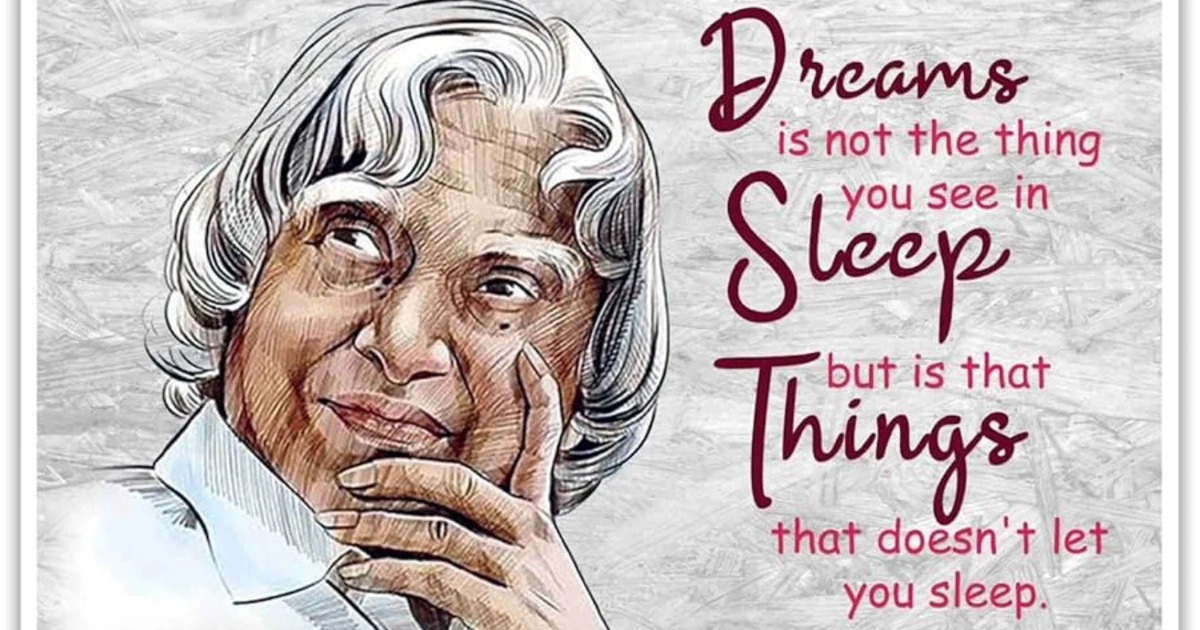
His most quoted line - that dreams are not what you see in sleep, but what stops you from sleeping - reframes ambition as sustained restlessness rather than fantasy.
3. Leadership means absorbing blame and distributing credit.
Satish Dhawan's example in 1979 became Kalam's operating principle. He repeated it throughout his career.
4. Simplicity is a strength, not a sacrifice.
A man who headed nuclear and missile programmes and served as Head of State owned almost nothing. His authority came from competence and integrity, not accumulation.
5. Technology must serve the poorest.
The stent, the callipers, PURA - he consistently redirected elite scientific capability toward the underprivileged. He measured technology by who it reached.
6. Secularism as lived practice.
He never separated his Muslim faith from his reverence for Indian civilisation. He recited the Quran and the Gita, worked with Hindu priests as a child, and refused to let identity become division.
7. Invest in the young.
He believed the transformation of a nation happens through its children. He spent his final moments doing exactly what he considered his highest calling - addressing students.
8. Self-reliance is national dignity.
His entire career was an argument that India should not depend on others for its security or its science.
9. Work until the end.
He collapsed mid-lecture at 83. He had no concept of retirement from purpose.
"If you want to shine like a sun, first burn like a sun." - A.P.J. Abdul Kalam