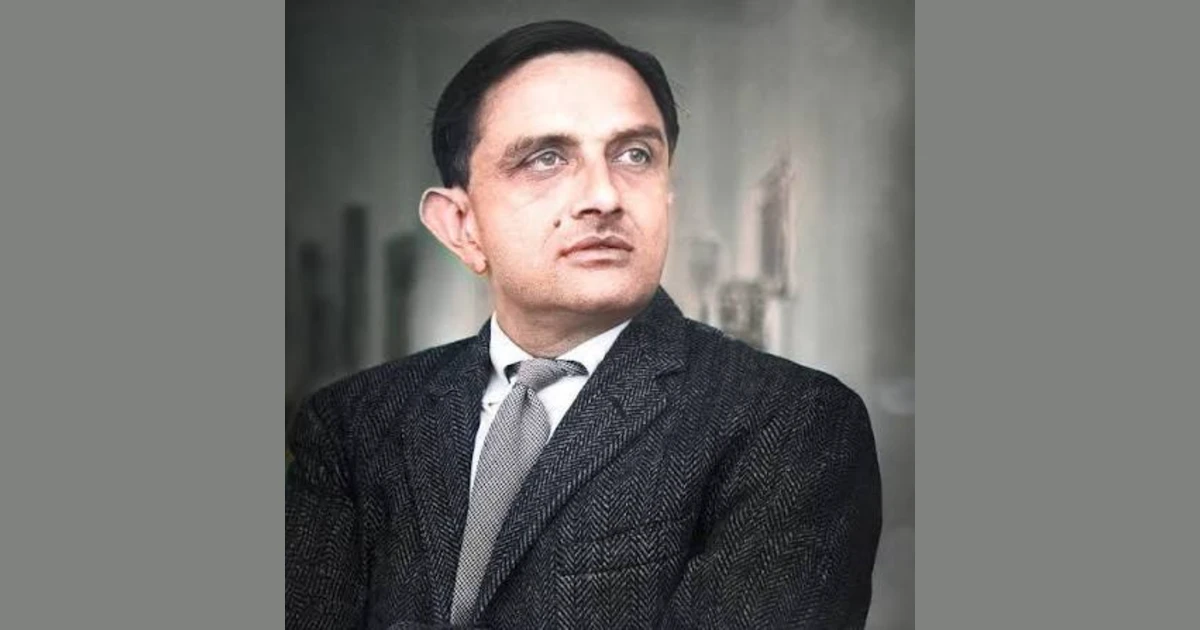
Vikram Ambalal Sarabhai (12 August 1919 – 30 December 1971) is remembered as the father of the Indian space programme, and his life is a study in how scientific ambition, industrial wealth, and nationalist purpose can be fused into institution-building.
Early life and family
He was born in Ahmedabad into one of India's most prominent industrialist families - the Sarabhais, Jain textile magnates whose home, "The Retreat," was a hub for the nationalist movement. His father Ambalal Sarabhai and mother Sarla Devi hosted Gandhi, Tagore, Jawaharlal Nehru, Motilal Nehru, C.V. Raman, Maria Montessori, and J.B.S. Haldane. This unusual childhood - being casually introduced to Gandhi and to Nobel laureates in the same drawing room - shaped his conviction that science and national service were inseparable.
Sarla Devi, dissatisfied with conventional schooling, established a private Montessori-method school on the family estate for her eight children, staffed with hand-picked teachers. Vikram was thus educated largely outside the standard system, in an environment that rewarded curiosity and experiment over rote learning.
Education
After matriculating from Gujarat College, Ahmedabad, he went to St John's College, Cambridge, taking his natural sciences tripos in 1940. The outbreak of the Second World War forced his return to India, where he joined the Indian Institute of Science, Bangalore, and began research on cosmic rays under C.V. Raman. It was in Bangalore that he met Homi J. Bhabha, a friendship and intellectual partnership that would later define India's atomic and space programmes.
He built cosmic ray telescopes and made observations at Bangalore, at Poona, and in the Himalayas at Kashmir and Gulmarg. He returned to Cambridge in 1945 and was awarded a PhD in 1947 for a thesis titled Cosmic Ray Investigations in Tropical Latitudes.
Marriage and personal life
In September 1942 he married Mrinalini Swaminathan, the celebrated Bharatanatyam and Kathakali dancer, in Chennai. Their marriage was conducted without any Congress leaders present - Gandhi had asked those close to him to devote themselves to the Quit India Movement then underway. They had two children: Kartikeya Sarabhai, who became an environmental educator, and Mallika Sarabhai, the dancer and activist. The marriage was not an easy one; Sarabhai's work consumed him, and in later years he was close to Kamala Chowdhry, a colleague at IIM Ahmedabad.
Institution-building
Sarabhai's greatest talent was creating institutions and then finding the right people to run them. In November 1947, at twenty-eight, he founded the Physical Research Laboratory (PRL) in Ahmedabad, initially in his family's Retreat, with support from the Karmkshetra Educational Foundation and the Ahmedabad Education Society. PRL began with cosmic ray and upper atmosphere research and became the cradle of Indian space science.
The list of institutions he founded or co-founded is remarkable for one lifetime:
- Physical Research Laboratory, Ahmedabad (1947)
- Ahmedabad Textile Industry's Research Association (ATIRA)
- Indian Institute of Management, Ahmedabad (1961), co-founded with Kasturbhai Lalbhai and modelled on Harvard Business School
- Community Science Centre, Ahmedabad (1966), later renamed the Vikram A. Sarabhai Community Science Centre
- Darpana Academy of Performing Arts, founded with Mrinalini
- Nehru Foundation for Development
- Faster Breeder Test Reactor, Kalpakkam
- Variable Energy Cyclotron Project, Calcutta
- Electronics Corporation of India Limited (ECIL), Hyderabad
- Uranium Corporation of India Limited, Jaduguda, Bihar
He also managed the family's Sarabhai Chemicals and other business interests, and founded Sarabhai Chemicals, Swastik Oil Mills, and other enterprises - an industrialist who happened also to be a first-rate physicist.
The Indian space programme
The launch of Sputnik in 1957 convinced Sarabhai that India needed a space programme. He made the case to the government in terms that remain the defining statement of Indian space policy: he argued that India should not fantasise about competing with advanced nations in exploring the Moon or planets or crewed spaceflight, but that if India was to play a meaningful role nationally and internationally, it must be second to none in applying advanced technologies to the real problems of people and society.
This is the crucial point about Sarabhai's vision - it was never about prestige. Space was to be an instrument of development: for communication in a country of hundreds of thousands of villages, for weather forecasting in an agrarian economy, for resource mapping.
In 1962 the Indian National Committee for Space Research (INCOSPAR) was established under his chairmanship, which in 1969 became the Indian Space Research Organisation (ISRO). With Bhabha's support he set up the Thumba Equatorial Rocket Launching Station (TERLS) near Thiruvananthapuram, chosen because it lay close to the geomagnetic equator - ideal for ionospheric and upper atmosphere studies. The first sounding rocket, an American Nike-Apache, was launched from Thumba on 21 November 1963. The site's first offices were in a church and a bishop's house; rocket parts were famously transported by bicycle and bullock cart.
After Bhabha's death in an air crash in January 1966, Sarabhai was appointed Chairman of the Atomic Energy Commission of India, carrying forward both the nuclear and space programmes simultaneously.
He negotiated with NASA to conduct the Satellite Instructional Television Experiment (SITE), which ran in 1975–76 after his death, beaming educational television to some 2,400 villages across six states - one of the largest social experiments using satellite communication ever attempted. He also laid the groundwork for the indigenous satellite programme; Aryabhata, India's first satellite, launched in 1975 from a Soviet cosmodrome, was a project he had initiated.
Scientific contributions
His own research was in cosmic rays and the physics of the upper atmosphere. He studied the time variations of cosmic ray intensity and showed how these were connected to solar activity and interplanetary space conditions - work that contributed to the understanding of solar-terrestrial relationships. He also established the connection between cosmic ray variations and geomagnetic phenomena. He published extensively and guided a generation of researchers at PRL.
It is more accurate to describe him as an experimental physicist and a builder of scientific capacity than as an "inventor" of specific devices - his contribution was the creation of the systems, institutions, and human capital that made Indian space and atomic science possible.
Positions held
- President, Physics section, Indian Science Congress (1962)
- President, General Conference of the IAEA, Vienna (1970)
- Vice-President, Fourth UN Conference on Peaceful Uses of Atomic Energy (1971)
- Chairman, Atomic Energy Commission of India (1966–1971)
- Chairman, INCOSPAR and ISRO
Awards and honours
- Shanti Swarup Bhatnagar Award (1962)
- Padma Bhushan (1966)
- Padma Vibhushan, awarded posthumously (1972)
- Honorary doctorates from several universities
After his death, the Thumba station's research centre was renamed the Vikram Sarabhai Space Centre (VSSC) in Thiruvananthapuram - ISRO's lead centre for launch vehicle development. A crater on the Moon in the Sea of Serenity was named the Sarabhai crater in his honour. The Vikram lander of the Chandrayaan-2 mission was named after him, and ISRO's Vikram series of processors carries his name. In 2019, his birth centenary year, ISRO and the Government of India held commemorations across the country.
Death
He died on 30 December 1971 at Kovalam, Thiruvananthapuram, aged 52, apparently of cardiac arrest, hours after addressing engineers at the Thumba station and having reviewed the design of the SLV rocket. He had been due to fly to Bombay the following morning. The suddenness of his death at the height of his powers - and coming only five years after Bhabha's - was a severe blow to Indian science. His last public act was characteristic: inaugurating a railway station at Thumba earlier that day and discussing rocket design that evening.
What we can learn from him
Technology must serve people, not prestige. Sarabhai deliberately refused the moon-race framing available to him, and directed a poor country's scarce resources towards satellites for education, weather, and communication. That decision continues to pay dividends. The discipline of asking "who does this actually help?" before "how impressive is this?" is his central lesson.
Build institutions, not monuments. He founded organisations and then trusted others to lead them - Satish Dhawan, A.P.J. Abdul Kalam, and many others were identified, empowered, and left to work. A leader's real output is the capacity that survives him.
Cross the boundaries. He was a physicist, an industrialist, a management theorist, and a patron of classical dance. IIM Ahmedabad exists because he thought management was a science India needed; Darpana exists because he thought art was not separable from a full life. Narrow specialisation was foreign to him.
Start before you are ready. The Indian space programme began in a fishing village, with a church for an office and bicycles for transport. He did not wait for ideal conditions; he began with what was available and improved it.
Privilege as obligation. Born to enormous wealth, he could have lived comfortably managing the family business. He chose instead to spend that wealth and access on building public scientific capacity.
Frugality and improvisation as method. The culture of low-cost, high-ingenuity engineering that still characterises ISRO - visible in the Mars Orbiter Mission's cost - traces directly back to the constraints and habits of Sarabhai's founding years.